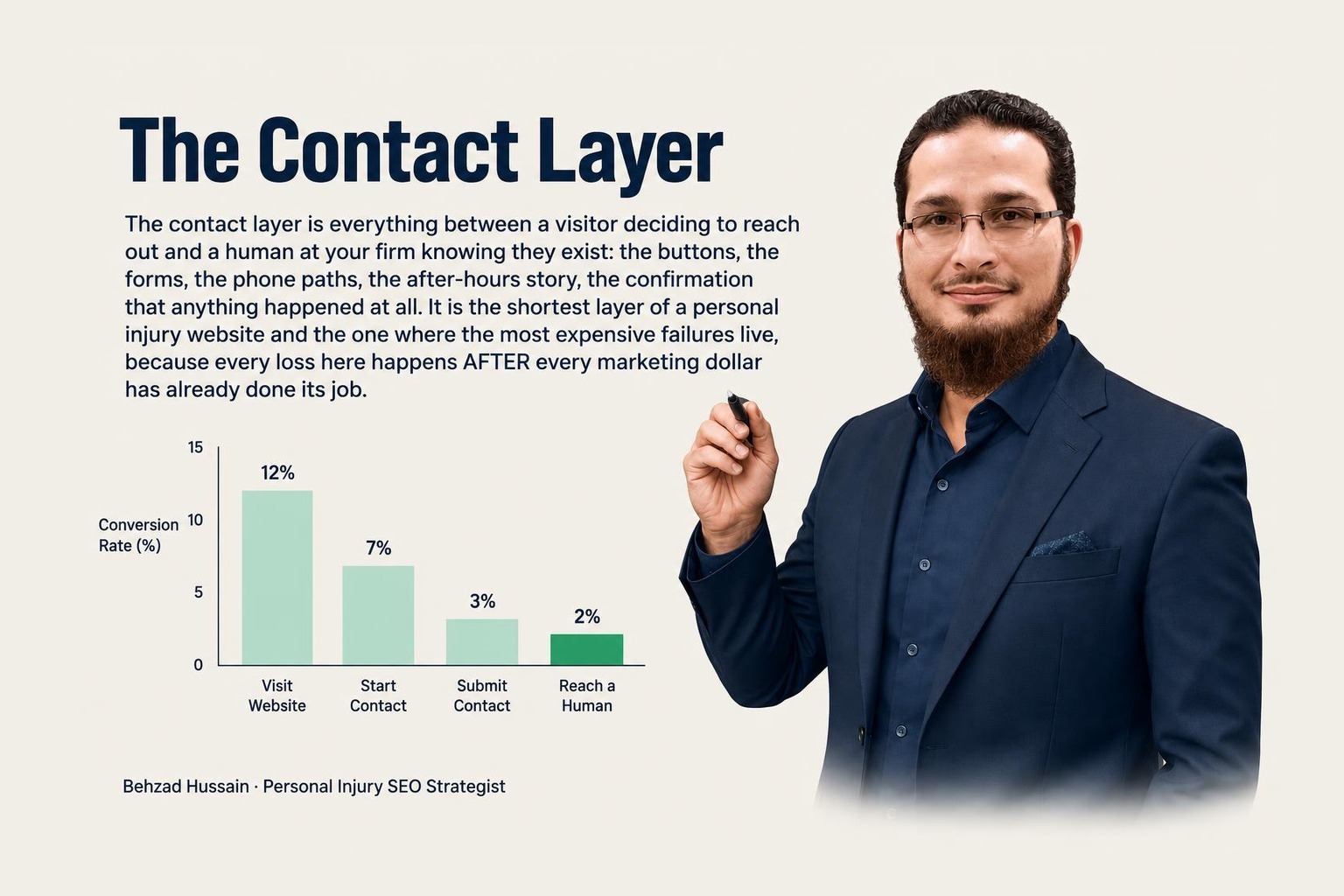
The contact layer is everything between a visitor deciding to reach out and a human at your firm knowing they exist: the buttons, the forms, the phone paths, the after-hours story, the confirmation that anything happened at all. It is the shortest layer of a personal injury website and the one where the most expensive failures live, because every loss here happens AFTER every marketing dollar has already done its job. This piece is the anatomy of that layer: what belongs on the first screen, what a form should ask, what the rules actually permit, and the silent failure that should keep owners up at night.
The economics of the last three centimeters
Everything upstream of the contact layer is paid for by the time it matters. The ranking was earned, the click happened, the page persuaded. The visitor's thumb is hovering. The remaining distance to a signed case is three centimeters of screen, and the vertical's own economics make every failure in those centimeters absurd: this is the industry that pays the highest click costs in search, then routes the resulting humans into fourteen-field forms and unanswered phone trees.
The machines are watching the same centimeters. Google patented calibrating click duration according to context, US 8868565: how visits end, and how quickly, is signal, interpreted against what the page and query were. A practice page that visitors flee because they could not find the way to act is not just losing those humans. It is teaching the system, visit by visit, how the page performs. Conversion failure and ranking decay are not separate problems; they share plumbing.
One more patent is worth knowing because of where it points. Google patented automatic routing of search results to a call, US 8312042: a voice query, a location, and the system treating a phone call as the natural completion of a search. The machinery has assumed for over a decade that the endpoint of local intent is a conversation. The firms whose contact layer agrees with that assumption inherit the intent; the ones that bury the phone number argue with the plumbing.
The first screen: both doors, always
The non-negotiable: a tap-to-call action AND a short written channel, both visible before any scroll, on the devices claimants actually hold.
The call button serves the person ready to talk. The form serves everyone else, and everyone else is a bigger group than this industry admits: the person in a hospital bed at 1am, the spouse researching from a work computer, the one who cannot say the words out loud yet, the one whose English is stronger written than spoken. A phone-only contact layer silently tells all of them to try the next firm. Almost nobody in this vertical offers the written door prominently, which makes it one of the cheapest differentiators available: being reachable by the frightened is a strategy, and it costs a form.
Placement is the test. Not whether a form exists somewhere below the awards, but whether both doors are standing open in the first screen of the pages where decisions happen: every practice page, every location page, the homepage, the attorney bios.
What the form should ask, and what it legally should not
The form itself is where firms sabotage the door they finally built. The errors run in both directions.
Too much: fourteen fields, demanding the whole story before saying hello. Every field is friction, and friction at the moment of fear is attrition. The form's job is not intake. It is contact: name, a way to reach you, a sentence about what happened. Three to five fields. The interview happens in the conversation the form exists to start.
Too much is also a rules problem, and this is the part most marketing vendors have never read. ABA Model Rule 1.18 governs prospective clients: people who consult a lawyer, including through a website, acquire protections, and information collected before a conflicts check creates real obligations. The rule's own commentary points at the design answer: reasonable measures to collect no more than needed to check conflicts before the relationship question is settled. The compliant form and the converting form are the same form: short, early, and modest about what it asks. Confirm the specifics with your own state's rules and your counsel, but the direction is friendly, not hostile, to good design.
And one reassurance owners constantly get wrong: responding quickly to someone who contacted YOU is not solicitation. Rule 7.3's restrictions govern contact the lawyer initiates. A prospect who reached out first has invited the response. Speed in answering your own inquiries is service, not an ethics risk.
The silent failure: the form nobody tested
Here is the failure mode that outranks every other in quiet damage: the form that stopped working, and nobody knew.
Forms are software. Software breaks: a plugin updates, a notification email starts routing to a mailbox someone abandoned, a spam filter eats the alerts, a redesign ships with the submit handler pointing nowhere. The page still looks perfect. Visitors still fill it in. The confirmations even fire. And the messages land in a void, for weeks, while the firm concludes the marketing stopped working.
I check this in every audit, and I check it the only way that counts: submit the form, then trace where the submission actually went and who actually saw it, including after hours. The ritual every firm should steal takes five minutes a month: someone submits a test inquiry through every form and calls the main line once, off-hours, and confirms a human saw both, with a timestamp. Put it on a recurring calendar, owned by a name. The firms that do this never star in the horror story. The horror story is exclusively populated by firms that were sure someone would have noticed.
The after-hours reality
Injuries do not keep office hours, and the searches that follow them peak in exactly the windows most firms go dark. Walk your own after-hours path once: call the main line at 9pm as a stranger and note what answers, a human, a service with a script, or a voicemail promising a callback that commits to nothing. Then submit the form and see when the first human acknowledgment actually arrives. Whatever that experience is, it is the firm your most urgent prospects meet, and it competes directly with whichever rival in your market answered. There are honest ways to cover the gap at every budget: a staffed line, an answering service briefed to collect the minimum and promise the specific, or at least a written channel whose response time is stated truthfully on the confirmation screen. What is not honest is the default most sites run: a first screen shouting call now above a line nobody answers. If the firm cannot staff the night, say so and route around it; the frightened forgive limited hours, stated plainly, far more readily than they forgive silence after being invited to speak.
Confirmation, expectation, and the first minutes
What happens in the seconds after submission decides how the next hours go. The confirmation screen should do three honest things: confirm a human will see this, say when a response will come, and give the escalation path if the matter cannot wait. Then the response itself has exactly three jobs: confirm receipt by a human, collect the minimum the conflicts check needs, and commit to a specific next step at a specific time. Not the consultation. Not the case evaluation. Contact, converted into a scheduled conversation while the moment is still warm.
None of this needs software you do not own or scripts your staff will not follow. It needs the contact layer treated as what it is: the revenue-bearing component of the entire marketing system, with an owner, a test ritual, and a standard that someone would notice being missed.
The audit you can run tonight
Open your highest-traffic practice page on your phone, on cellular. Without scrolling: can you tap to call, and is there a short written way in? Count the form's fields. Submit it. Time how long until any human acknowledges, and note whether the acknowledgment commits to anything specific. Then do it once more at 9pm.
That half hour tells you more about your case acquisition than the last three ranking reports combined. The contact layer is Pillar 4 of my framework, Case Acquisition Optimization, and its questions sit in my free PI Authority Scorecard precisely because they are the ones owners can answer tonight and almost never have: 90 seconds, scored, with a personalized PDF and a short Loom back.
The full intake and conversion material is free on my site at behzadhussain.me and the research behind the patterns at behzadhussain.me
Marketing fills the top of the funnel. The contact layer is the bottom, three centimeters long, where everything either becomes a case or quietly does not. Walk those centimeters yourself, tonight and again at 9pm, before you spend another dollar widening the top.